


Like most Americans, Christine Kuehn always mourned the tragedy at Pearl Harbor, haunted by the some 2,400 souls who perished in the stunning Dec. 7, 1941, attack.
She even made the hallowed site a priority during her 1989 Hawaiian honeymoon, solemnly sailing toward the USS Arizona Memorial and reflecting on the carnage that shaped history.
“You think to yourself, ‘How awful for the families that were destroyed.’ It was the first time we’d ever really been attacked on our home soil,” Kuehn told The Post ahead of the anniversary.
“Everybody’s kind of in their own head, thinking about how many souls were lost, how many men were sacrificed. You think, ‘How could this happen?’ ”
Kuehn was “blissfully ignorant” about her family’s shocking secret.
But when a mysterious letter arrived years later, asking about her family’s involvement in the horrific strike, Kuehn, then a Maryland-based mom of three young children, felt her quiet suburban life turn upside down.
With the latest anniversary, Kuehn again feels that acute pain — not because her family bore witness to one of the most tragic days in US history but knowing they were in on it.
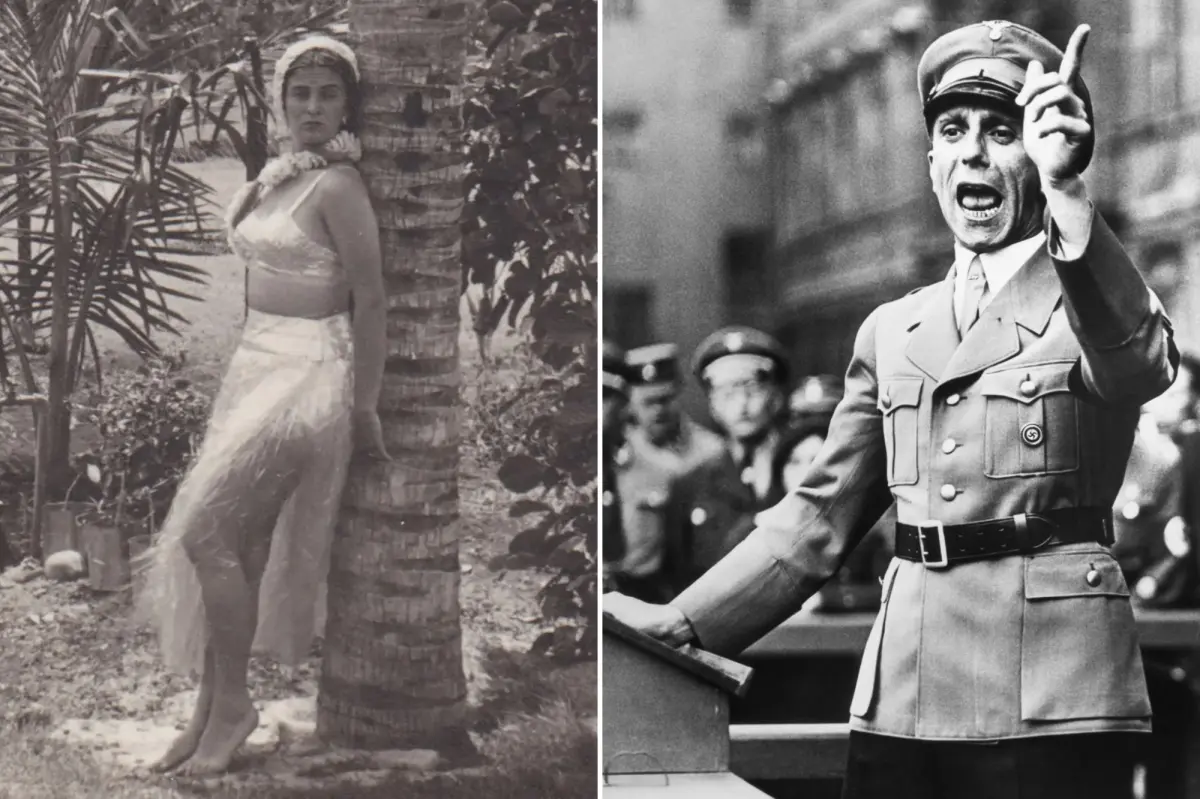
That bombshell letter set off what would become a 30-year search for the truth — uncovering how her aunt Ruth’s affair with Joseph Goebbels went bust when he discovered she was half Jewish, sending Ruth and her Nazi parents to be spies in Hawaii to help the Japanese orchestrate the then-deadliest attack on American soil, plunging the country into World War II.
Kuehn, 62, creates a riveting narrative in her new book, “Family of Spies: A World War II Story of Nazi Espionage, Betrayal, and the Secret History Behind Pearl Harbor” (Celadon Books).
It’s the astonishing story of how the author comes to grips with her own Nazi relatives in a high-stakes family drama that reads like a spy thriller.
Kuehn’s dad, Eberhard, was always reticent about his childhood — born in Berlin in 1926 and raised in Hawaii — while whitewashing details of his family life and keeping his daughter almost entirely in the dark.
Yet there were never any major red flags until one summer day in 1994, when a screenwriter working on a WWII project reached out in search of information about the Kuehns’ elaborate spy ring.
It must be the wrong family, she thought, frantically reassuring herself the Kuehns were “true-blue patriotic Americans,” knowing Eberhard, a Bronze Star recipient, fought in the South Pacific and proudly hung an American flag outside the house every Fourth of July.
She dialed up her 70-year-old widower dad — a lovable if hulking figure with a residual German accent that she writes “frightened my friends half to death” — expecting him to outright dismiss the left-field letter so she could return to her normal life.
At first he deflected, then sobbed, admitting he tried to “shield” his Crissie from the painful truth, just like he was shielded while raised unknowingly in a family in the thick of Nazi espionage.
With a reporting background, Kuehn quickly sprang into action, unearthing reams of redacted FBI files and government archives to uncover her family’s dark past.
She discovered the stomach-churning details about her forebears who climbed the Nazi Party ranks and aided Japan by passing along sensitive intel on the American Pacific fleet.
She single-handedly blew up her family’s seismic half-century secret along with her own sense of sanctity.
Growing up, she believed her father’s sanitized account that Grandpa Otto was a naval officer with an unexceptional career who died suddenly in a traffic accident.
But the real Otto led a life that was anything but nondescript.
He was a “narcissist with big dreams, a German patriot who blamed the English and their allies for his family’s misfortunes in World War I,” Kuehn writes, revealing her brash grandfather’s hopeless inability to fly under the radar as a covert spy.
“He was vain, grandiose, a risk-taker.”
Born into an affluent German family with its own castle, Otto became destitute and disillusioned upon returning from WWI during the Weimar Republic years and later glommed onto the Nazi party for redemption.
The fledgling group exploded in popularity on the heels of the 1929 US stock market crash that sent Germany’s economy spiraling — a catastrophic event Hitler used to capture downtrodden Germans in search of hope.
And as a vehicle to whale on any perceived enemies.
Otto’s new social-climbing wife, Friedel, came with two young children — Leopold from one relationship and Ruth from another, with a Jewish architect.
It would put her squarely in the crosshairs of the very bloodthirsty Nazi Party to which Otto would devote his life.
Yet when Ruth, a 19-year-old Nazi Youth alum, met 37-year-old propaganda chief Goebbels at a party, the unlikely duo embarked on a steamy but brief affair — no doubt cut short by Ruth’s inconvenient background.
Otto, meanwhile, was making his own mark.
He narrowly lost out on becoming Heinrich Himmler’s right-hand man as head of the Gestapo in 1931, a monstrous role that went to rival Reinhard Heydrich, better known as The Butcher of Prague, who went on to become a key architect of the Holocaust.
Instead, the ne’er-do-well Otto secured a different job with the Nazi secret police.
Goebbels’ need to expunge Ruth fit neatly with her family’s skill set to help the regime’s future ally, Japan, in need of Caucasian spies at Pearl Harbor.
So by 1936 the family, which also included half-siblings Eberhard, 9, and 3-year-old Hans, set sail for Honolulu to enjoy beach and serious bank.
“Otto would be Tokyo’s man in Hawaii,” Kuehn writes of the move half a world away, where her grandparents would spend the next six years enjoying wild beachside bacchanals and passing secrets to their Japanese handlers while collecting princely sums of cash totaling in the millions today.
The cunning and comely Ruth could use her feminine wiles to entertain unguarded naval officers, while Otto would groom his military connections with “lavish parties at Honolulu hotels and opulent gatherings at the Kuehn home,” writes the author.
Friedel would open a beauty shop looking to extract military intel from the chatty naval wives.
But their cover stories were as paper thin as a cocktail umbrella.
The Kuehns’ over-the-top lifestyle landed them in the local gossip pages, catching the attention of FBI Special Agent Robert L. Shivers, who was always within a hairbreadth of nailing the careless spy operation.
National Archives would reveal a February 1939 FBI memo from J. Edgar Hoover, ordering agents to determine if the mysterious Germans were espionage agents.
Buying a steel company — affording access to Pearl Harbor’s facilities and eventually earning a contract inside the officers’ lounge — was a strategic coup for the otherwise sloppy Otto.
“Back home, he formulated an elaborate system of signals involving lights from the dormer window in his house to communicate with Japanese submarines waiting off the east coast of Oahu,” Kuehn writes.
Otto’s ostensible reason for moving to Hawaii was to learn Japanese, but Shivers discovered he could barely sputter out a sentence after more than four years of language lessons.
“Agents would have to keep weaving these small details, strands of evidence, into an elaborate tapestry that Shivers knew, he absolutely knew, would eventually expose the Kuehns’ intelligence operation,” the author writes.
The storytelling is as stomach-churning as it is cinematic, especially leading up to the twisty crescendo, known as “X Day” in Tokyo.
The first time Kuehn’s dad, Eberhard, discovered the truth about his own Nazi parents was the day the FBI knocked on the door and arrested him — on the evening of Dec. 7, when he was 15.
Both Eberhard and younger brother Hans would later have to testify against their father in court.
Horrified by her family’s shocking past, Kuehn’s instinct was to lean into the family default mode: cone of silence.
“I didn’t tell anyone — I was embarrassed and wanted to keep it a secret,” she told The Post from her Maryland home.
It would take time to come to terms with her own Nazi DNA.
“I would move forward and think, ‘OK, I’m past that. I’m good. I understand I’m not my grandparents,’ ” she said.
“And then you find out some other tidbit, some other information that was more horrific than the one before, and I could find myself sliding backwards.”
The enormity of it all, like coming across a photo of her uncle Leopold, her dad’s older half-brother, posing in his Nazi uniform with swastika armband on his wedding day, got to her.
“He’s looking at his wife, and he’s so young, and she’s so happy to be standing next to him,” Kuehn recalled with disgust. “I couldn’t really face some of the stuff I was learning.”
The stench of the association was enough to make her wash her hands of the whole research project for a decade.
But as more sensational stories — some of which took wild creative liberties, like accusing kiddo Hans of being an active agent — trickled out about her family, Kuehn “went into journalism mode.”
Kuehn described taking a powerless situation and empowering herself.
“I couldn’t let someone else tell my family story,” she said. “I couldn’t change the past and my history, but I could discover the truth and create this book, a piece of history that’s been untold for years.”
Today, Kuehn is at peace with her family and her place in it, becoming more comfortable speaking about their dark spot in history.
“I’ve definitely started to heal,” she said, noting she addresses Jewish communities that include Holocaust survivors’ descendants.
“You’re not a reflection of your grandfather — you don’t carry the sins of him,” audiences reassure her. “That’s been healing for me.”
Her hardest-learned lessons are families have secrets, “and we’re sometimes afraid to share them,” she said, noting the value of personal agency. “You aren’t the legacy of your bloodline.”
Her greatest message is no one should have to carry the burden of their kin’s sins.
“I hope people walk away saying, ‘Whatever that secret is, I can be different. I don’t have to carry that,’ ” she declared.
“Anyone can be a different person and leave a different imprint on this world.”