


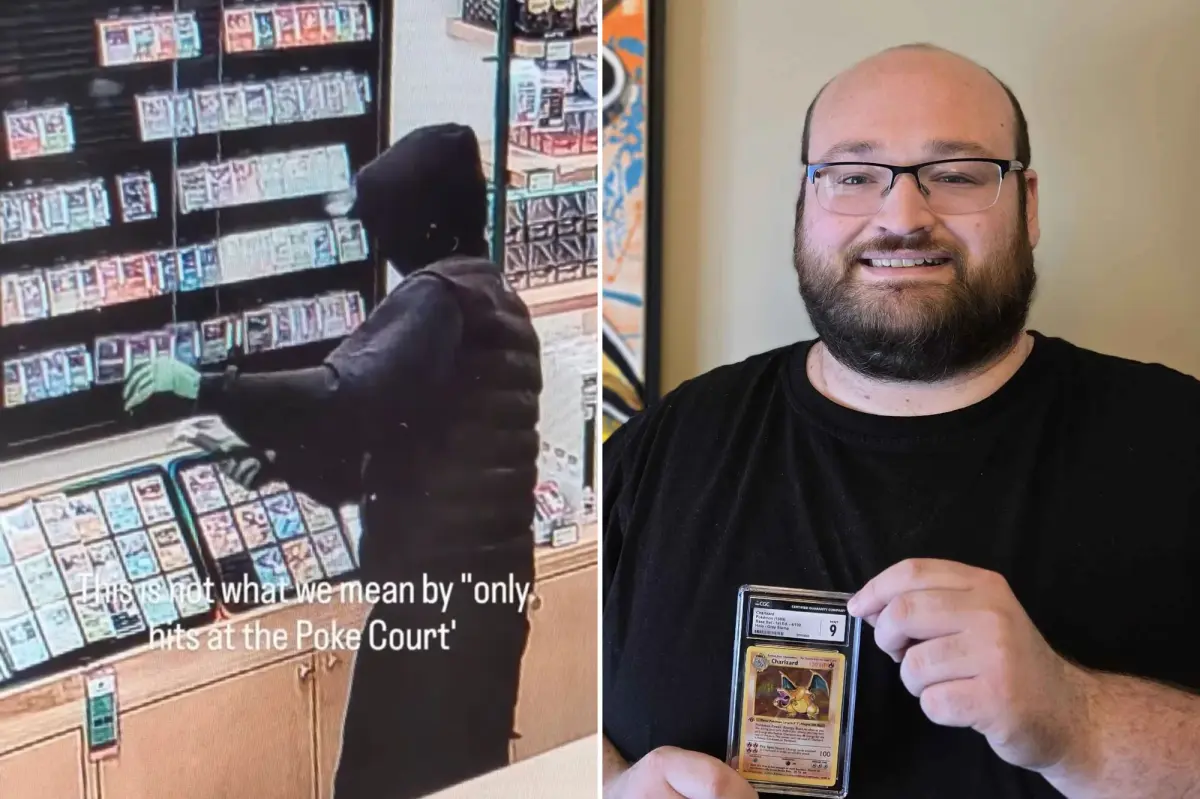

Never mind diamonds and cars. One of the hottest items for thieves to boost right now is Pokémon cards — and insiders say it might be the perfect crime.
“The cards are fungible and unregistered,” collector Charlie Hurlocker, who has some 10 million cards worth “millions and millions” of dollars, told The Post, adding that stolen ones are easy for thieves to unload: “You don’t need a black market.”
Earlier this month, gun-wielding thugs stormed into an event at Poké Court in Manhattan’s Meatpacking District, smashing display cases and grabbing $110,000 worth of cards, including a first-edition Charizard valued at some $15,000.
In the past weeks, there have been similar heists in Wilmington, North Carolina, which led to a game-store employee being beaten up; Atlanta, where $100,000 worth of Pokémon cards was taken in a Christmas Eve break-in; and Gardena, California, where thieves dropped through the ceiling of a shop.
In Houston, three stores were recently targeted — with thieves cutting through a wall shared with a neighboring business to get in one — and a home burglary led to a collector losing $55K in cards.
“Owners of collectable stores have to treat themselves as if they’re jewelry stores,” said Goldin. “They need to have the right security and the right protection. They have to lock up their valuables at night.”
Sometimes things turn violent, like when a man was held up at gunpoint after leaving RWT Collective in Los Angeles’ Sawtelle neighborhood and relieved of a briefcase containing Pokémon cards worth $300,000.
It’s no wonder Logan Paul travels with bodyguards.
When the pro wrestler and social media star decided to auction off his one-of-a-kind PSA 10 Pikachu Illustrator card, he knew what he needed to do before traveling to Goldin Auctions’ Runnemede, NJ, headquarters.
“I just gotta bring a security team to move it with me,” Paul told auction house head Ken Goldin.
“I’ve got a bunch of armed guards here,” Goldin, who stars in “King of the Collectibles: The Golden Touch” on Netflix, said he gold Paul. “We can meet you.”
Paul bought the card for $5.275 million and Goldin believes it could go for twice that in the bidding that closes on February 15. It is currently at $5.1 million ($6.324 million with the buyer’s premium).
Clearly, some people are taking the Pokémon slogan “Gotta Catch ‘Em All” very seriously.
Very rare cards are rated for condition by a recognized agency such as Professional Sports Authenticator (PSA), which seals authenticated cards into 6-millimeter-thick acrylic or polycarbonate cases.
That should deter some thieves, as the case “has a serial number and barcode. If you try to sell it to a retailer, the code will be scanned and it will come up as stolen.”
But “if you use enough brute force, you can break it open. You just take a hammer to it. Then it’s like having a dollar bill” in terms of its inability to be traced, one store owner — who was robbed of inventory worth six figures — told The Post.
Hurlocker said it’s pretty easy for thieves to move stolen cards online “or at a card show … Recovery is difficult to impossible in most cases. It’s a decentralized buyer pool.”
And, he added, thieves are “less likely to be pursued by the police for a jewelry heist.”
The company Corocoro Comics used to offer Pokémon cards, which launched in Japan in 1996, as contest prizes. (Pokémon is now a Nintendo brand.)
Paul’s flex-worthy Illustrator, which he wears on a chain around his neck, was one of 10 cards given away as prizes in a a drawing contest. More than one person described it to The Post as “the holy grail.” It’s the only one of the set believed to remain in existence.
When Pokémon hit the US in 1999, the cards quickly became playground currency.
“My parents didn’t have money to buy me packs of cards,” said Hurlocker. “So, I was wheeling and dealing, seeing what I could trade for Pokémon cards. I just worked the playground and built up a collection.” ( “I don’t keep them in my home because I’m not a moron,” he asked The Post to make clear.)
Now, nostalgia drives the market.
People still want the cards “they couldn’t get as kids,” said Goldin.
Part of why prices have held, said Goldin, is because Pokémon characters are make-believe and can’t screw up or get sidelined like their human sports-card counterparts do: “They don’t get caught using steroids, they don’t get in trouble with girlfriends, they don’t tear their ACLs.”